
How to Summarize Anything: The Complete 2026 Guide
How to summarize anything sounds simple — read something long, write something short. In practice, most people get it wrong. They either copy half the original word-for-word, or strip it down so far the meaning disappears. This guide walks through every framework worth knowing (the 5 W's, the 3-2-1 strategy, the 7-step method), shows you how to summarize different formats (articles, books, paragraphs, YouTube videos, meeting notes), and tells you exactly when to stop doing it manually and let an AI do the heavy lifting in 10 seconds.
What summarizing actually means
A summary is a shorter version of a source text that preserves its main ideas in your own words. It is not a quote, a paraphrase of one paragraph, or a list of every fact you found interesting. A good summary is shorter than the original by at least 70%, leaves out examples and side stories, and could stand alone as the only thing someone reads about the source.
The reason most summaries fail is that people start writing before they finish reading. You cannot compress what you do not yet understand.
The 5 basic rules of summarizing
Every summarizing framework eventually boils down to the same five rules. Memorize these and you will never write a bad summary again.
1. Read the whole thing first. No notes, no highlighting — just read. 2. Identify the main idea in one sentence before you write anything else. 3. Use your own words. If you copy phrases verbatim, you are quoting, not summarizing. 4. Keep proportions. If a topic took up 10% of the original, it gets roughly 10% of your summary. 5. Cut examples, anecdotes, and repetition. They support the main idea — they are not the main idea.
The 5 W's framework (the fastest way to start)
The 5 W's — Who, What, When, Where, Why — is the simplest summarizing technique on the planet, which is why journalists have used it for over a century. Before you write a single word, answer all five out loud.
Who is the story about? What happened? When did it happen? Where? And most importantly, why does it matter? Once you have those five answers, you have a summary. Stitch them into two or three sentences and you are done.
The 3-2-1 and 4-2-1 strategies (great for studying)
These two strategies come from the classroom, but they work just as well for adults trying to retain articles, podcasts, or books.
3-2-1: Write down 3 things you learned, 2 things you found interesting, and 1 question you still have. It forces you to separate facts from reactions.
4-2-1: A slightly heavier variant — 4 key points, 2 connections to something you already knew, and 1 way you'll use the information. It is the better choice when you actually need to remember something long-term, not just summarize it.
The 7-step method for writing a great summary
When the stakes are higher — a report, an executive briefing, a study guide — use the long version.
1. Read the source twice. Once for flow, once for structure. 2. Identify the thesis: what is the author actually arguing? 3. Underline (or note) the topic sentence of every section. 4. Write a one-sentence main idea in your own words. 5. Write a one-sentence summary of each section. 6. Stitch them together — main idea first, sections in order. 7. Cut 20%. Your first draft is always too long.
Same article, 5 tones — see ToneSummary in action
Here is what makes ToneSummary different from every other AI summarizer: you can summarize the same source in multiple tones in a single click and pick the one that fits your audience. Same facts, different voice.
The source paragraph (60 words, news-style): "NASA's Artemis II crew completed their final integrated training simulation this week, clearing one of the last milestones before the planned 2026 lunar flyby. Engineers say the spacecraft is on schedule and that no major issues surfaced during the 36-hour rehearsal, which covered launch, transit, and emergency reentry scenarios."
Below is the same paragraph summarized in the five free ToneSummary tones. Notice how the facts stay identical — only the voice shifts to match the audience.
| Tone | Summary |
|---|---|
| Professional summary | Artemis II crew finished their final integrated simulation this week, leaving the 2026 lunar flyby on schedule with no major issues from the 36-hour rehearsal. |
| Casual summary | The Artemis II team just wrapped their last big training run, and everything looked good — they're still on track for the 2026 trip around the Moon. |
| Funny summary | NASA's Moon crew survived a 36-hour pretend mission with zero meltdowns, which is honestly more than most people manage on a Tuesday. Lunar flyby still on for 2026. |
| Sarcastic summary | Shocking news: NASA did a really long practice run and nothing broke. The Moon trip is, somehow, still scheduled for 2026. |
| Executive summary | Artemis II completed final integrated rehearsal. Schedule unchanged: 2026 lunar flyby. No blocking issues. |
Build your own persona library with custom AI tones (Pro)
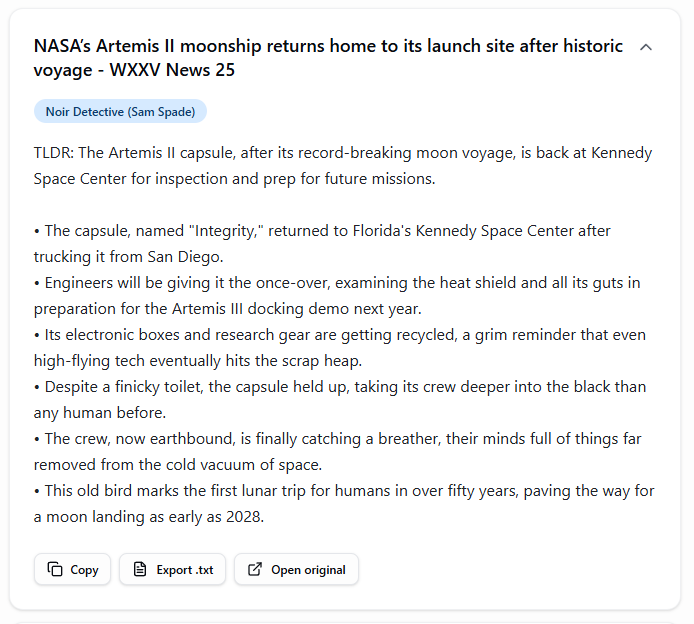
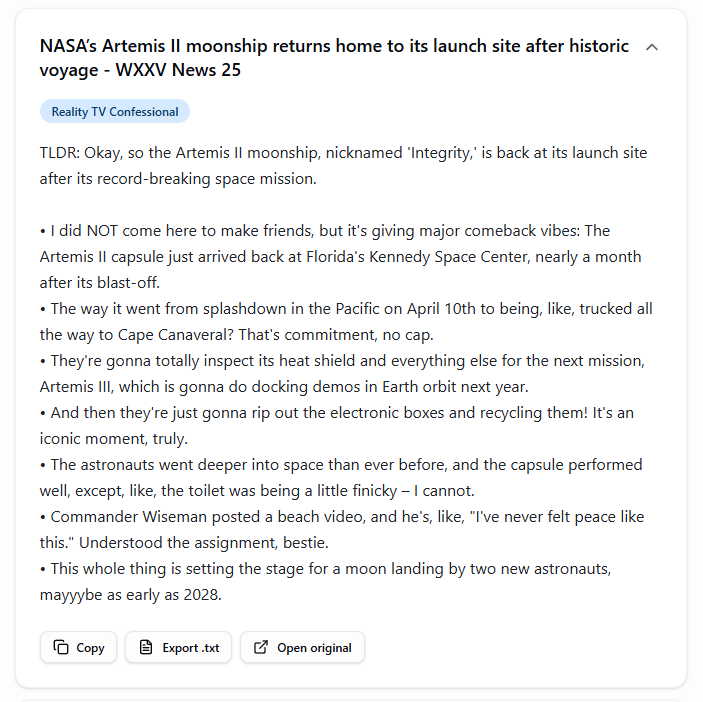
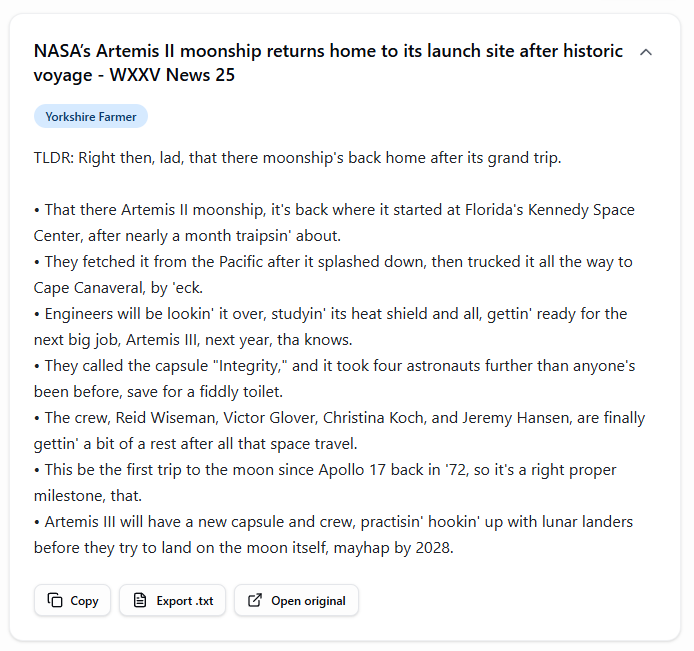
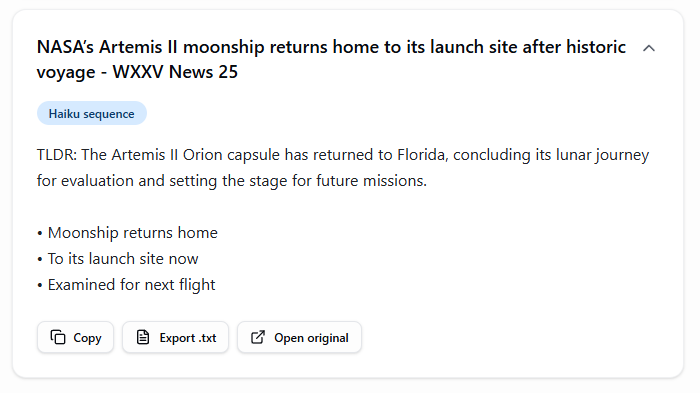
The five built-in tones cover most everyday summarizing needs, but Pro users can save up to 10 of their own custom AI tones — reusable personas with a distinctive voice, vocabulary, and rhythm. Save it once, then apply it to any URL with one click.
Below are five real custom personas summarizing the same NASA Artemis II news article. Notice how each one keeps the facts identical but completely transforms the voice — proof that custom tones reshape not just vocabulary but pacing, structure, and personality.
1920s Newsreel Announcer — period-piece broadcaster with "EXTRA! EXTRA!" energy and spelled-out years. Great for novelty intros, social posts, or genuinely fun group chats.

How to summarize different formats
The framework is the same. The shortcuts are different.
Articles: The first and last paragraphs usually contain the thesis and conclusion. Read them first, then skim the middle for support. If you'd rather skip the manual work, paste any URL into a professional summarizer and get a clean version in seconds — that is exactly what we built ToneSummary for.
Books: Use the table of contents as your skeleton. Summarize each chapter in one sentence, then summarize those sentences into a single paragraph. The book's introduction and conclusion are usually a free summary the author already wrote for you.
Paragraphs: Find the topic sentence (usually first or last). Everything else is support. Your summary is the topic sentence rewritten in fewer words.
Stories: Use a story arc — setup, conflict, resolution. Skip subplots. A novel summary should never run more than one paragraph.
YouTube videos: Read the transcript instead of watching. You read 3–4x faster than people speak. Most videos have a YouTube-generated transcript under the 'Show transcript' button — paste it into a casual summarizer if it is for friends, or an executive summary if it is for your boss.
Meeting notes & lecture slides: Capture decisions, action items, and owners. Skip the discussion. If nobody has to do anything because of what was said, it does not belong in the summary.
Audience matters: a meeting-notes example
Same 90-second meeting, two very different readers. This is where picking the right tone (instead of a one-size-fits-all summary) actually pays off.
Source: "The team agreed to delay the v3 launch by two weeks so engineering can finish the new caching layer. Marketing will hold the press release. QA needs two more testers. Decision: Maya owns the new timeline and will share an updated Gantt chart by Friday."
| Tone | Best for | Summary |
|---|---|---|
| Executive summary | Forwarding to leadership | v3 launch slipped 2 weeks (caching work). Maya owns new timeline; Gantt by Friday. PR on hold. QA needs 2 more testers. |
| Sarcastic summary | Group chat with the team | We're 'only' two weeks late because caching is hard. Maya gets to redo the Gantt. PR is in cryo. QA still understaffed, obviously. |
Common mistakes (and what NOT to do when summarizing)
Most bad summaries share the same handful of flaws. Avoid these and you're ahead of 90% of people.
Don't copy and paste. Even one borrowed sentence makes it a quote, not a summary. Don't add your opinion. A summary tells the reader what the source said, not what you think about it. Don't include examples. They illustrate the main idea — they aren't the main idea. Don't change the meaning. Compressing a nuanced argument into 'X is good' or 'X is bad' is the fastest way to mislead your reader. Don't summarize before you understand. If you can't explain the thesis in one sentence, you're not ready to write.
When to summarize manually vs. use AI
Manual summarizing builds comprehension. AI summarizing buys back time. The right choice depends on why you're doing it.
Do it manually when you're studying, preparing to teach, or need to deeply understand something. The act of compressing it is what locks it into your memory.
Use AI when you're triaging — a 40-tab reading list, a stack of articles your team sent you, or a long PDF you need the gist of before deciding whether to read it properly. A modern AI summarizer can give you a clean, readable summary in any tone (professional, casual, executive, even sarcastic) in under 10 seconds.
ToneSummary is free for the first 5 summaries every day with no account required. Sign up free for 10/day, or check the pricing page for higher limits and Pro-only tones like Academic, Journalist, and ELI5.
| Situation | Best approach |
|---|---|
| Studying for an exam | Manual (3-2-1 or 4-2-1) |
| Triaging a reading list | AI summarizer |
| Briefing your team | AI draft, then edit by hand |
| Long PDF or report | AI executive summary |
| Meeting notes | Manual (decisions + action items only) |
| YouTube video | AI on the transcript |
| A book you love | Manual (chapter by chapter) |
The shortcut: paste a URL, pick a tone, done
If you've read this far, the honest answer is that for 80% of summarizing tasks in 2026, the fastest path is to paste a URL into an AI summarizer and pick the tone that fits your audience. Professional for work, casual for friends, executive for leadership, sarcastic for the group chat — and a custom Yorkshire Farmer for the days you need a laugh.
What ToneSummary does that other AI summarizers don't:
1. Multiple tones in a single click — compare a professional summary, casual summary, and executive summary side-by-side without re-running anything. 2. Saved custom AI tones (Pro) — train your own persona once ("Noir Detective", "1920s Newsreel", or your own brand voice) and reuse it on every article. 3. 10-second turnaround on any URL, PDF text, or pasted article.
Free for the first 5 summaries every day, no signup. Free account: 10/day. Pro: 100/day plus 10 expert tones and up to 10 saved custom personas. Try it on the next article you were going to skim.
Frequently asked questions
How do I summarize something?
Read the whole thing first, identify the main idea in one sentence, then write 2–3 sentences in your own words that cover Who/What/When/Where/Why. Cut examples and repetition. For speed, paste the URL into an AI summarizer like ToneSummary and pick the tone that fits your audience.
What are the 5 basic rules of summarizing?
Read the whole text first, identify the main idea, use your own words, keep the original proportions, and cut examples and repetition.
How do you write a good summary?
Use the 7-step method: read twice, find the thesis, mark each section's topic sentence, write a one-line main idea, summarize each section in a sentence, stitch them together, then cut 20%.
What are the 5 steps in summarizing a text?
1) Read the text fully. 2) Identify the thesis. 3) Note each section's key point. 4) Write a draft in your own words. 5) Trim until only the essential ideas remain.
What not to do when summarizing?
Don't copy and paste, don't add your opinion, don't include examples, don't change the meaning, and don't start writing before you fully understand the source.
What is the 4-2-1 summarizing strategy?
Write 4 key points, 2 connections to something you already know, and 1 way you'll use the information. It's designed for retention, not just summarization.
What is the 3-2-1 summarizing strategy?
Write 3 things you learned, 2 things you found interesting, and 1 question you still have. It's a fast way to lock in a summary while studying.
What are the 5 W's in summarizing?
Who, What, When, Where, and Why. Answer all five and stitch them into 2–3 sentences — that's a summary.
What are common mistakes in summaries?
Including too much detail, copying phrases word-for-word, adding personal opinion, oversimplifying nuanced arguments, and writing before fully understanding the source.
What's the best way to summarize an article?
Read the first and last paragraphs first to find the thesis, then skim the middle. For speed, paste the URL into an AI article summarizer like ToneSummary and pick the tone that fits your audience — professional for work, casual for friends, executive for leadership.
Try ToneSummary free
Paste any article URL and get an instant summary in your chosen tone. 5 free per day, no signup.
Summarize an article →Keep reading
Beyond the Bullet Points: The Art of Summarizing Anything Effectively
Learn the essential techniques for summarizing any text effectively, from articles to meetings. Discover how AI tools like ToneSummary can streamline your summarization process.
ReadUnlock the Power of Meeting Summaries: Boost Productivity & Clarity
Discover how effective meeting summaries can transform your team's productivity, improve decision-making, and ensure clear communication. Learn best practices and tools.
ReadBest Way to Summarize an Article in 2026 — I Tested 7 Tools
I tested 7 ways to summarize an article in 2026. See which AI summarizer won — including ToneSummary's unique multi-tone feature.
Read